Moon and astronomy
New Moon vs First Crescent: Not the Same Evening
The astronomical new moon is invisible; an Islamic month starts with the first crescent. Learn moon age, conjunction and why the dates differ by a day or two.
By Tahir Nasuru · · 8 min read
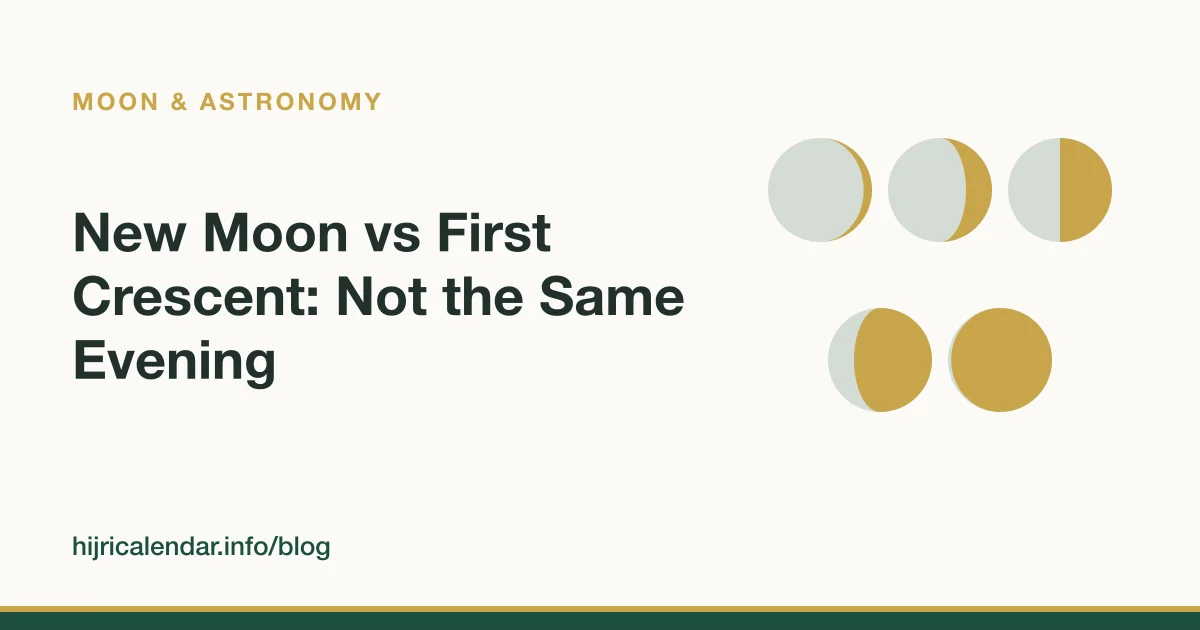
The new moon is an astronomical moment: the instant the Moon passes the Sun's position in the sky, when its lit side faces away from Earth and nothing can be seen. The first crescent (the hilal) is the thin sliver of light that appears in the western sky after sunset, usually about a day later. An Islamic month traditionally begins with the crescent, not with the new moon. That is why a calendar can show a new-moon icon on one day and the first of the Hijri month one or two days after it.
Key Takeaways
- The new moon (conjunction) can be computed to the minute, but the Moon is not visible at that moment.
- The hilal is a visible crescent after sunset. The US Naval Observatory says sighting it within one day of new moon is usually difficult.
- Moon age is the time since the new moon. A crescent only a few hours old is too faint and too close to the Sun to see.
- Calculated calendars such as Umm al-Qura start the month by rule, so their first day may or may not match a local sighting.
What the astronomical new moon is
The new moon is a single instant, not a whole day. The US Naval Observatory's crescent visibility page defines it as the moment when the Sun and Moon have the same geocentric ecliptic longitude. Astronomers often call this the conjunction, because the two bodies line up as seen from the centre of the Earth.
At that moment the Moon is between the Earth and the Sun, so the side facing us is in shadow. The USNO page on lunar phases states plainly that the Moon is not visible at new moon, except during a solar eclipse. Even if it were lit, it would sit in the Sun's glare.
Because it is an instant, the new moon happens at one moment for the whole world, but it falls on different calendar dates in different time zones. USNO's moon phase tables give times in Universal Time. A moon-phase icon on your phone shows that same moment converted to your local clock.
What the first crescent (hilal) is
The hilal is not a calculation. It is something a person sees, or does not see, low in the west just after sunset. After conjunction the Moon moves steadily eastward away from the Sun. As the gap grows, a thin lit edge appears, and the Moon sets later after the Sun each evening.
Whether that edge can actually be seen depends on more than the clock. USNO lists sky conditions and the location, experience and preparation of the observer. It says sighting the crescent within one day of new moon "is usually difficult," It notes naked-eye sightings reliably reported as early as 15.5 hours after new moon, and telescope sightings as early as 12.1 hours, but says "these observations are exceptional" and should not be expected as the norm.
R.H. van Gent of Utrecht University, in his introduction to predicting first visibility, notes that astronomers have worked on this problem for more than four millennia, and that planetarium software can show where the Moon is but cannot predict whether it will be seen. The criteria astronomers use today are covered in how crescent visibility is predicted.
Why the Islamic month follows the crescent
The Quran refers to the crescents by name. Surah al-Baqarah 2:189 begins, in the Saheeh International translation of the meaning on quran.com: "They ask you, [O Muḥammad], about the crescent moons." The Arabic word is al-ahilla, the plural of hilal, and the verse goes on to call them measurements of time for people and for Hajj.
The hadith link the start of the fast to seeing the crescent. In Sahih al-Bukhari 1906, the Prophet ﷺ said not to fast until the crescent is seen and not to stop fasting until it is seen again, and to estimate if the sky is overcast. The narration in Sahih al-Bukhari 1909 says that in that case Sha'ban is completed to thirty days.
So the event that matters in the texts is the visible hilal. The new moon only marks the earliest point after which a crescent becomes possible. How communities apply this today, by local sighting, sighting elsewhere, or calculation, is a question on which Muslims differ, and personal decisions belong with qualified scholars and your local mosque. The main approaches are laid out in moon sighting vs calculation.
Moon age: the gap between the two
Moon age is the time elapsed since the new moon. It is the simplest way to see why the two events rarely share an evening.
| Astronomical new moon | First crescent (hilal) | |
|---|---|---|
| What it is | An instant of alignment | A visible sliver after sunset |
| Can it be seen? | No (except in a solar eclipse) | Yes, if conditions allow |
| Can it be predicted exactly? | Yes, to the minute | Only as a likelihood |
| Typical moon age | 0 hours | Roughly a day or more |
| Same for everyone on Earth? | Same instant, different local dates | Depends on where you stand |
If the new moon falls in the afternoon, the Moon at that evening's sunset is only a few hours old: far younger than even the exceptional early sightings USNO cites. Often it sets before the Sun, so there is nothing above the horizon to look for. By the next evening it is roughly a day older, sets later, and may be visible. In some months the first sighting comes a further evening later.
Age alone does not decide visibility. A crescent of the same age can be easy to see from one place and impossible from another, depending on its height above the horizon, how long it stays up after sunset, and the season. Those measures are explained in reading a crescent moon forecast.
Why calendars show a new moon before the month starts
A printed or online Hijri calendar is usually calculated in advance. This site uses the Umm al-Qura calendar of Saudi Arabia. According to van Gent's summary of the Umm al-Qura rules, since 1423 AH (March 2002) the next day is the first of a new month if two conditions are met on the 29th: the geocentric conjunction happens before sunset, and the Moon sets after the Sun. Otherwise the month runs to 30 days. Van Gent explains that this puts the crescent above the horizon at Makkah (often only just) at the start of the month.
Under this rule the month always starts after the astronomical new moon, so the new-moon icon always comes first. The rule does not require the crescent to be seen. Van Gent notes that in most cases (about 75%) the crescent is not visible to the naked eye on the first evening of the month as seen from Makkah or elsewhere in Saudi Arabia. A calculated first day can therefore come before a local sighting.
Example 1: the new moon two days before the month
Method: Hijri dates are calculated from the Umm al-Qura tables in the open-source hijri-converter library that this calendar uses; new-moon, sunset and moonset times come from USNO data for Makkah (UTC+3), and moon ages are computed from those times.
- Monday 9 November 2026 (29 Jumada al-Awwal 1448): the new moon falls at 07:02 UT, which is 10:02 in Makkah. The International Astronomical Center's Jumada al-Thani 1448 page gives the same conjunction time. That evening, the USNO Sun and Moon data service (query: Makkah, 21.42° N 39.83° E, time zone UTC+3, 9 November 2026) gives sunset at 17:41 and moonset at 17:35. The Moon sets first, so the second condition fails.
- Tuesday 10 November: the calendar shows 30 Jumada al-Awwal. At sunset (17:40) the Moon is about 31.6 hours old and sets at 18:19, 39 minutes after the Sun.
- Wednesday 11 November: 1 Jumada al-Thani 1448. As an Islamic day it begins at sunset on Tuesday.
A new-moon icon on Monday, the crescent evening on Tuesday, and the first of the month on Wednesday's calendar square: three different dates for what people often treat as one event. The calculated Jumada al-Thani 1448 calendar shows these dates.
Example 2: the month starts the evening of the new moon
- Wednesday 9 December 2026 (29 Jumada al-Thani 1448): the new moon falls at 00:52 UT, which is 03:52 in Makkah. ICOP's Rajab 1448 page gives the same time. The same USNO query for 9 December 2026 gives sunset at 17:39 and moonset at 17:52, so both conditions hold.
- Thursday 10 December: 1 Rajab 1448 in the calculated Rajab 1448 calendar, beginning at sunset on Wednesday.
At that Wednesday sunset in Makkah, the Moon is about 13.8 hours old. That is younger than the earliest naked-eye sighting USNO reports as reliable (15.5 hours), so this month starts by calculation on an evening when the crescent is very unlikely to be seen there without optical aid. Local sighting committees may start Rajab a day later.
The same moment also lands on different local dates. In New York (UTC-5 in December), 00:52 UT is 19:52 on Tuesday 8 December, so a phone there marks the new moon on Tuesday, two calendar days before 1 Rajab.
Common questions
Is the "new moon" in Islam the same as the astronomical new moon?
In everyday English, "new moon" is often used for the first crescent, and some translations render hilal that way. In astronomy, the new moon is the invisible conjunction. When reading a calendar or a news report, check which one is meant.
Can the crescent be seen on the evening of the new moon?
Rarely. If the new moon happens only a few hours before sunset, the Moon is too young, too thin and too close to the Sun. USNO reports reliable naked-eye sightings as early as 15.5 hours after new moon, and calls such early sightings exceptional, not the norm.
Why does my calendar disagree with my mosque by a day?
A calculated calendar applies a fixed rule ahead of time, while many communities wait for a sighting or follow a particular announcement. Neither is broken; they answer different questions. Treat the calculated date as a planning estimate and confirm the start of important months locally.
What to do next
To see when the next new moon falls and how the Moon's illumination grows through the month, open the moon phases page. For any date in the calculated Umm al-Qura calendar, use the date converter, and remember that the Islamic day begins at the sunset before the date shown. For Ramadan, Eid and other key dates, confirm the start of the month with the local authority you follow.