Calendar basics
How Many Days Are in a Hijri Year? 354, 355 and Leap Years
A Hijri year has 354 or 355 days: 12 lunar months of 29 or 30 days. See why, how tabular leap years work, and computed lengths for 1444-1452 AH.
· 9 min read
Clear, sourced guides to the Hijri calendar: how Islamic months begin, what each month marks, holiday dates, moon sighting, date conversion and prayer time science.
Written by Tahir Nasuru. Read our editorial policy or subscribe with RSS.
Calendar basics
A Hijri year has 354 or 355 days: 12 lunar months of 29 or 30 days. See why, how tabular leap years work, and computed lengths for 1444-1452 AH.
· 9 min read
Calendar basics
Lunar Hijri follows the moon (354 or 355 days); Solar Hijri, Iran's official calendar, starts at Nowruz. Both count from 622. How to tell them apart.
· 8 min read
Calendar basics
The tabular Islamic calendar fixes month lengths by rule: 11 leap years in every 30-year cycle. See the variants, the two epochs and where it is used.
· 9 min read
Calendar basics
The Umm al-Qura calendar is Saudi Arabia's calculated Hijri calendar. Learn its month rule, how the rules changed, and why it is not a moon sighting.
· 9 min read
Calendar basics
AH stands for Anno Hegirae, the year of the Hijra. See where year 1 AH starts, why 2026 minus 622 gives the wrong year, and how to estimate correctly.
· 8 min read
Calendar basics
The Hijri calendar is the Islamic lunar calendar: 12 months of 29 or 30 days, a 354 or 355-day year, counted from the Hijra of 622 CE.
· 9 min read
Calendar basics
Islamic dates move about 11 days earlier each year because 12 lunar months last about 354 days. See the arithmetic and the 33-year cycle.
· 6 min read
Calendar basics
The Islamic day runs from sunset to sunset, so each Hijri date starts the evening before. See what that means for Laylat al-Qadr, Eid eve and Friday night.
· 7 min read
Islamic months
Dhu al-Qi'dah (Dhul Qadah) is the 11th Hijri month and a sacred month. Learn its name, the Prophet's Umrahs in it, and its 1448 AH calculated dates.
· 7 min read
Islamic months
Jumada al-Awwal and Jumada al-Thani are the 5th and 6th Hijri months. Learn what Jumada means, why it is also called al-Ula and al-Akhirah, and their dates.
· 7 min read
Islamic months
Muharram, meaning the sacred, is the first Hijri month. Learn its place among the four sacred months, the Ashura fast and calculated dates to 2030.
· 6 min read
Islamic months
Rabi al-Awwal is the third Hijri month. Learn what its name means, how the Hijra and the Prophet's birth and death link to it, and its 2027 dates.
· 7 min read
Islamic months
Rajab is the 7th Hijri month and one of four sacred months named by the Prophet ﷺ. Learn its sources, the 27 Rajab debate and which narrations are weak.
· 8 min read
Islamic months
Safar is not an unlucky month. See the sahih hadith 'no Safar', what pre-Islamic Arabs believed about it, how early scholars explained it, and its 1449 dates.
· 7 min read
Islamic months
Sha'ban is the 8th Hijri month, just before Ramadan. Read the sahih hadith on the Prophet's Sha'ban fasts, the mid-Sha'ban debate and making up missed fasts.
· 8 min read
Islamic months
The six days of Shawwal are voluntary fasts after Ramadan, from 2 Shawwal on. See the Sahih Muslim hadith, consecutive or spread, and 1448 calculated dates.
· 7 min read
Islamic months
The first ten days of Dhu al-Hijjah run from the 1st to Eid al-Adha on the 10th. See the hadith, each day's meaning, and calculated dates for 1448 AH.
· 9 min read
Islamic months
The four sacred months are Dhu al-Qi'dah, Dhu al-Hijjah, Muharram and Rajab. See Quran 9:36, the hadith naming them, and calculated dates for 1448-1449.
· 8 min read
Holidays and observances
Ashura is the 10th of Muharram. See the sahih hadith on its fast, why many Muslims add the 9th, how Karbala shapes the day, and the calculated dates for 2027.
· 7 min read
Holidays and observances
Laylat al-Qadr is sought in the odd nights of Ramadan's last ten. Why each night starts at sunset, how 29 or 30 days change the count, and 2027 dates.
· 8 min read
Holidays and observances
The Prophet ﷺ made a point of fasting Mondays and Thursdays. See the hadith, how these fasts overlap the white days and Ashura, and which days to skip.
· 8 min read
Holidays and observances
Eid al-Adha falls on 10 Dhu al-Hijjah, the day after pilgrims stand at Arafah. See the days of tashriq, the Saudi announcement and the sacrifice window.
· 9 min read
Holidays and observances
Ramadan begins if the crescent is seen on the evening of 29 Sha'ban; if not, Sha'ban runs to 30 days. How sighting, calculation and announcements work.
· 7 min read
Holidays and observances
The Day of Arafah is 9 Dhu al-Hijjah, when pilgrims stand at Arafat. See the hadith on fasting it, why pilgrims don't fast, and the 2027 calculated date.
· 8 min read
Holidays and observances
The Islamic New Year is 1 Muharram, the first day of the Hijri year counted from the Hijra of 622. See why Umar chose it, how it is kept, and the 2027 date.
· 6 min read
Holidays and observances
The White Days (Ayyam al-Bid) are the 13th, 14th and 15th of each Hijri month. See the hadith, gradings, full-moon link and calculated dates for 1448 AH.
· 7 min read
Holidays and observances
Eid al-Fitr varies by country because Ramadan can end after 29 or 30 days, communities use different sighting rules, and the crescent favours the west.
· 9 min read
Holidays and observances
Ramadan fasting hours run from dawn to sunset, so they depend on season and latitude. Calculated examples for 7 cities show fasts of about 9 to 21 hours.
· 8 min read
Moon and astronomy
Crescent visibility criteria use moon age, lag, altitude and elongation to estimate if the hilal can be seen. See how Danjon, Yallop and Odeh compare.
· 10 min read
Moon and astronomy
Local sighting follows the crescent seen in your own region; global sighting accepts it from anywhere. The Kurayb hadith, the arguments and why dates differ.
· 9 min read
Moon and astronomy
Moon age, lag time, altitude and elongation explained, with a real HMNAO forecast, ICOP's map key and a worked example for Ramadan 1448.
· 11 min read
Moon and astronomy
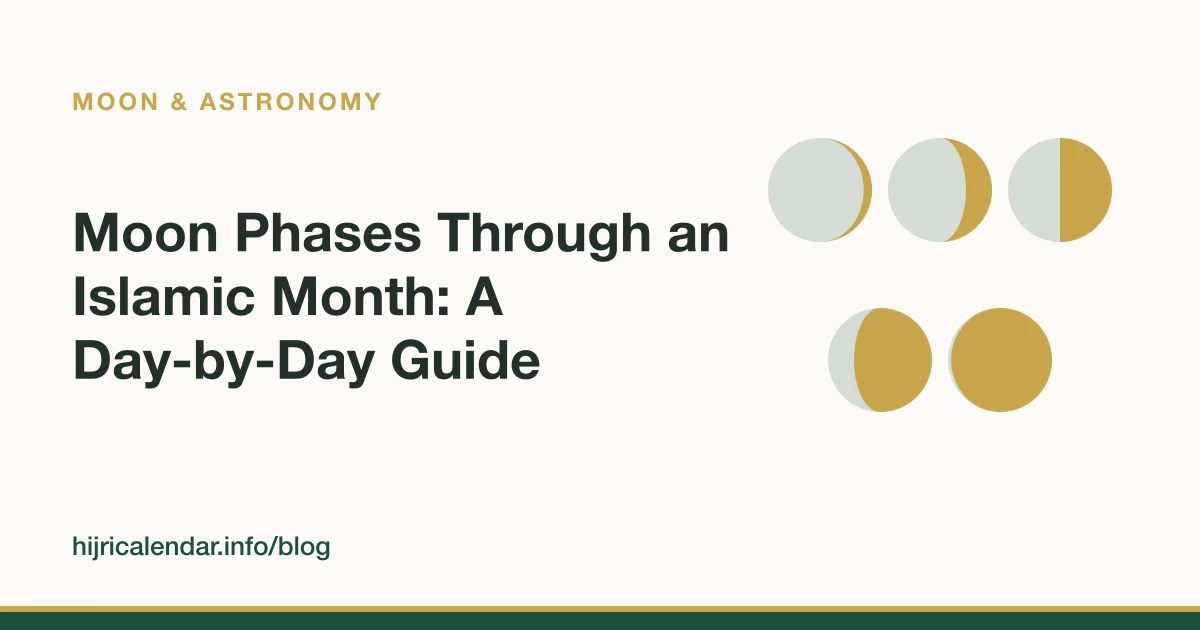
In an Islamic month the crescent appears around day 1, the half moon near day 7, full moon on day 14 or 15 and last quarter around day 21 or 22. Here is why.
· 10 min read
Moon and astronomy
Some Muslims start each month by sighting the crescent, locally or anywhere; others by calculation. See the main positions, their sources and a 2026 example.
· 10 min read
Moon and astronomy
The astronomical new moon is invisible; an Islamic month starts with the first crescent. Learn moon age, conjunction and why the dates differ by a day or two.
· 8 min read
Moon and astronomy
An Islamic month has 29 or 30 days. See the hadith behind the rule, the 29.53-day lunar cycle, and why a cloudy evening means a 30-day month.
· 9 min read
Dates and conversion
Your age in Hijri years is about 3% higher than your Gregorian age: one extra year every 32.6 years. See the maths, worked examples and when it matters.
· 7 min read
Dates and conversion
Convert any Gregorian date to the Hijri calendar: a quick formula accurate to about two days, the exact converter method, and a month-table check.
· 8 min read
Dates and conversion
Convert your birth date to the Hijri calendar, add a day if you were born after sunset, and see why your Hijri birthday comes about 11 days earlier each year.
· 7 min read
Dates and conversion
Convert a Hijri expiry date on a Saudi document with an Umm al-Qura converter, read the هـ and م markers, and confirm deadlines on the official portal.
· 7 min read
Dates and conversion
Hijri converters differ because they use different calendars: Umm al-Qura tables, tabular (Kuwaiti) rules or astronomical estimates. How to choose one.
· 9 min read
Dates and conversion
The hawl, or zakat year, is a lunar year of 354 or 355 days. See the hadith, how to fix a Hijri zakat date, and where the 2.577% solar-year rate comes from.
· 8 min read
History
The Hijri calendar was started by the caliph Umar ibn al-Khattab around 17 AH (638 CE). See the dating problem, the consultation and why the Hijra was chosen.
· 7 min read
History
A lunar calendar follows only the moon; a lunisolar one adds leap months to stay with the seasons. See how the Islamic, Hebrew and Chinese calendars differ.
· 9 min read
History
Nasi was the pre-Islamic practice of shifting the sacred months, possibly with a leap month. See Quran 9:37, the Farewell Sermon and why Hijri months drift.
· 8 min read
History
The Hijra was the Prophet's 622 CE migration from Makkah to Madinah. See why it marks year 1 AH and why its exact date is still debated.
· 8 min read
History
The Hijra is traditionally placed in Rabi al-Awwal, yet the Hijri year opens in Muharram. See the reasons reported, from Umar's council to Fath al-Bari.
· 8 min read
Prayer time science
Fajr and Isha angles measure how far the sun is below the horizon. See which bodies use 15°, 18° or 19.5°, and how many minutes apart they are by latitude.
· 8 min read
Prayer time science
Prayer times follow the sun: solar noon for Dhuhr, shadow length for Asr, sunset for Maghrib, twilight for Fajr and Isha. The formulas, with a worked example.
· 9 min read
Prayer time science
Twelve prayer time calculation methods side by side: Fajr and Isha rules, minute offsets, London times for each, and checks against official timetables.
· 9 min read
Prayer time science
From New York the Qibla is a northeast bearing of about 58 degrees. See why the direction to Makkah follows a great circle, with bearings for nine cities.
· 7 min read