Moon and astronomy
Moon Phases Through an Islamic Month: A Day-by-Day Guide
In an Islamic month the crescent appears around day 1, the half moon near day 7, full moon on day 14 or 15 and last quarter around day 21 or 22. Here is why.
By Tahir Nasuru · · 10 min read
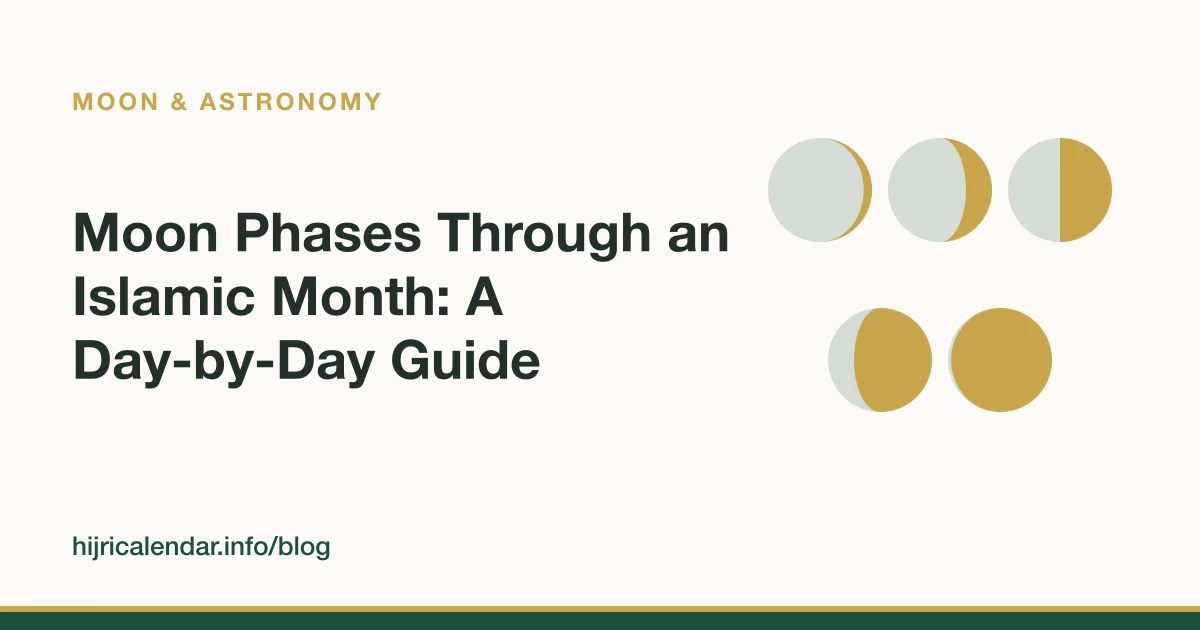
Because an Islamic month begins with the new crescent, the moon phases line up with Hijri dates in a way they never do on the Gregorian calendar. A thin crescent appears in the west after sunset around the 1st of the month. The Moon is half lit (first quarter) around the 7th, full on the 14th or 15th, half lit again (last quarter) around the 21st or 22nd, and invisible near the 29th, just before the next month begins. Once you know the date in the Hijri month, you can roughly picture the Moon, and the reverse.
Key Takeaways
- The Hijri date works as a rough Moon dial: crescent near day 1, first quarter near day 7, full moon on day 14 or 15, last quarter around day 21 or 22.
- In the calculated Umm al-Qura year 1448 AH, every full moon fell on the 14th or 15th of the month, and every first quarter on the 7th or 8th.
- The pattern drifts by a day because the gaps between phases vary and because a month's first day depends on a rule or a sighting, not on the new moon itself.
- The 13th, 14th and 15th of each month, the "white days", are the nights around the full moon.
Why Hijri dates track the Moon
A Hijri month starts when the new crescent appears, or when a calculated rule says it would, so the date restarts with the Moon's cycle every month. The Gregorian calendar has no such link: a full moon can fall on any date from the 1st to the 31st.
The Quran describes the Moon's changing shape as a measure of time. Surah Yasin 36:39 says, in Dr. Mustafa Khattab's The Clear Quran translation of the meaning: "As for the moon, We have ordained ˹precise˺ phases for it, until it ends up ˹looking˺ like an old, curved palm stalk." Surah Yunus 10:5 links those phases to knowing "the number of years and calculation ˹of time˺."
The cycle of phases repeats every 29.5 days on average, according to both the US Naval Observatory's lunar phases page and NASA's guide to moon phases. That is why a Hijri month has either 29 or 30 days, a point covered in more depth in why an Islamic month has 29 or 30 days.
The phases, defined
Astronomers fix the four main phases by the angle between the Moon and the Sun as seen from Earth. USNO defines new moon, first quarter, full moon and last quarter as the moments when the Moon is 0, 90, 180 and 270 degrees east of the Sun in ecliptic longitude. The same page gives the share of the visible disc that is lit: 0% at new moon, 50% at each quarter and 100% at full moon.
Between those four instants are four in-between phases:
- Waxing crescent: less than half lit, growing. This is the hilal of the new month.
- Waxing gibbous: more than half lit, growing toward full.
- Waning gibbous: more than half lit, shrinking after full.
- Waning crescent: less than half lit, shrinking toward the next new moon.
"Waxing" means the lit part is growing and "waning" means it is shrinking. In both quarters the Moon looks like a half disc, even though the phase is called a "quarter": the first quarter comes a quarter of the way through the cycle and the last quarter three-quarters of the way through.
The Islamic month, stage by stage
The table below gives the usual day range for each stage. The Hijri days are the daytime dates of the calculated Umm al-Qura calendar. The illumination figures are from one real month, Jumada al-Thani 1448 (11 November to 9 December 2026). We computed them with the open-source suncalc library, the same engine behind the site's moon phases page, at 15:00 UT on each date, which is 18:00 in Makkah, shortly after sunset there. Remember that each Islamic day begins at the sunset before the date shown.
| Hijri days | Phase | Where and when to look | Illumination (Jumada al-Thani 1448) |
|---|---|---|---|
| 29 or 30 of the previous month | New moon | Nothing: the Moon is beside the Sun | about 0% |
| 1 to 3 | Thin waxing crescent | A low sliver in the west, setting soon after the Sun | 5% to 17% |
| 4 to 6 | Waxing crescent | A wider crescent, higher in the evening sky | 24% to 42% |
| 7 or 8 | First quarter | A half moon, high in the evening sky | about 51% on day 7 |
| 9 to 13 | Waxing gibbous | A bright, swelling Moon, up most of the evening | 71% to 98% |
| 14 or 15 | Full moon | A round Moon rising in the east around sunset | about 100% on day 14 |
| 16 to 20 | Waning gibbous | The Moon rises later each night, after dark | 94% to 57% |
| 21 to 23 | Last quarter | A half moon rising around midnight | about 46% on day 21 |
| 24 to 28 | Waning crescent | A thinning crescent in the east before dawn | 18% to 0.3% |
NASA's moon phases guide describes where to look at each phase: the first quarter is "high in the sky in the evening", the full moon "rises at sunset and sets at sunrise", the last quarter rises around the middle of the night, and the waning crescent rises in the early morning before sunrise.
Days 1 to 3: the crescent
The first crescent is the thinnest Moon of the month and the hardest to see. USNO's crescent visibility page says that sighting it within one day of new moon "is usually difficult", and that the youngest reliable naked-eye reports are about 15.5 hours after new moon.
On a calculated calendar, day 1 does not always mean a crescent was visible the evening before. The Umm al-Qura rule starts a month once the new moon has happened and the Moon sets after the Sun at Makkah, which can be before a sighting is possible. The difference is explained in new moon vs first crescent. Over the next two or three evenings, the crescent is easy to find: a little thicker and a little higher each night.
Days 4 to 6: a growing crescent
As NASA puts it, "every day, the Moon rises a little bit later." In practice the crescent stands higher at sunset each evening and stays up longer after Maghrib. In Jumada al-Thani 1448 the lit share grows from about 24% on the 4th to 42% on the 6th.
Days 7 and 8: first quarter
By the end of the first week the Moon is half lit and well clear of the Sun. At sunset it stands high in the sky. In Jumada al-Thani 1448 the first quarter fell at 11:48 UT on 17 November, which is the 7th of the month.
Days 9 to 13: waxing gibbous
After first quarter the Moon is more than half lit and brighter each evening. It is already well up at sunset and stays in the sky for most of the night. By the 13th, the first of the white days, it is close to full: about 98% lit in Jumada al-Thani 1448.
Days 14 and 15: the full moon
The middle of the month is the full moon. The Moon sits opposite the Sun, so it rises around sunset and sets around sunrise, as USNO notes for most places on Earth. On 24 November 2026 (14 Jumada al-Thani 1448), the full moon fell at 14:53 UT. USNO's Sun and Moon data for one day gives Makkah a moonrise of 17:19 and a sunset of 17:37 that evening.
This is also the only part of the month in which a lunar eclipse can happen: NASA's eclipse types page states that lunar eclipses occur at the full moon phase. The opposite end of the month is where solar eclipses fall, since USNO notes the new moon is not visible except during a solar eclipse.
Days 16 to 20: waning gibbous
After full moon the lit part shrinks, and NASA notes that the Moon "rises later and later each night." By the 20th it rises well after dark, so the early evening sky is moonless again.
Days 21 to 23: last quarter
In the last third of the month the Moon is a morning object. At last quarter it rises around the middle of the night, so it is usually not in the sky after Maghrib. At dawn it is still high in the sky, and NASA notes that it sets around midday.
Days 24 to 28: the old crescent
The waning crescent rises shortly before dawn in the east, getting thinner each morning. By the 29th it is lost in the Sun's glare, and the cycle closes with the next new moon.
How exact is the pattern?
The pattern is reliable to within a day or so. To test it, we took the USNO table of primary moon phases for 2026 and 2027, converted each time to Makkah time (UTC+3), and looked up the calculated Umm al-Qura date of that calendar day for every phase in the year 1448 AH. The Hijri day here is the daytime date; a phase that falls after sunset in Makkah belongs, by Islamic reckoning, to the evening that begins the next day.
| Phase | Hijri day in 1448 AH (12 months) |
|---|---|
| First quarter | 7th in 11 months, 8th in 1 |
| Full moon | 14th in 6 months, 15th in 6 |
| Last quarter | 21st in 6 months, 22nd in 5, 23rd in 1 |
| New moon | 29th in 11 months, 30th in 1 |
The month-by-month figures behind that tally are below, as Hijri day with the Makkah date and time (UTC+3) in brackets. Months 1 to 7 fall in 2026 and months 8 to 12 in 2027.
| Month (1448 AH) | First quarter | Full moon | Last quarter |
|---|---|---|---|
| Muharram | 7 (22 Jun 00:55) | 15 (30 Jun 02:56) | 22 (7 Jul 22:29) |
| Safar | 7 (21 Jul 14:05) | 15 (29 Jul 17:36) | 23 (6 Aug 05:21) |
| Rabi al-Awwal | 7 (20 Aug 05:46) | 15 (28 Aug 07:18) | 22 (4 Sep 10:51) |
| Rabi al-Thani | 7 (18 Sep 23:44) | 15 (26 Sep 19:49) | 22 (3 Oct 16:25) |
| Jumada al-Awwal | 7 (18 Oct 19:12) | 15 (26 Oct 07:12) | 21 (1 Nov 23:28) |
| Jumada al-Thani | 7 (17 Nov 14:48) | 14 (24 Nov 17:53) | 21 (1 Dec 09:08) |
| Rajab | 8 (17 Dec 08:42) | 15 (24 Dec 04:28) | 21 (30 Dec 21:59) |
| Sha'ban | 7 (15 Jan 23:34) | 14 (22 Jan 15:17) | 21 (29 Jan 13:55) |
| Ramadan | 7 (14 Feb 10:58) | 14 (21 Feb 02:23) | 21 (28 Feb 08:16) |
| Shawwal | 7 (15 Mar 19:25) | 14 (22 Mar 13:44) | 22 (30 Mar 03:54) |
| Dhu al-Qi'dah | 7 (14 Apr 01:56) | 14 (21 Apr 01:27) | 21 (28 Apr 23:18) |
| Dhu al-Hijjah | 7 (13 May 07:44) | 14 (20 May 13:59) | 22 (28 May 16:58) |
Two things move a phase by a day.
The gaps between phases are not equal. The time from one phase to the next changes from month to month. In the USNO data for 2026 and 2027, the gap from new moon to full moon ranges from about 13.9 to 15.6 days, and a full cycle from new moon to new moon ranges from about 29.3 to 29.8 days.
The first day of the month moves too. A month can begin one evening after the new moon or two evenings after it, depending on the calculation rule or on when the crescent is seen. If your community starts the month a day later than the calculated calendar, every phase above shifts one day earlier in your local count: the full moon might fall on the 13th or 14th instead.
Time zones add a smaller effect. A phase is a single instant worldwide, so a full moon at 02:00 UT falls on one date in Makkah and the previous evening in the Americas. USNO lists phase times in Universal Time for this reason.
The white days and the full moon
The 13th, 14th and 15th of each Hijri month are known as the white days (al-ayyam al-bid), and they are the three days around the full moon. In Jami' at-Tirmidhi 761, the Prophet ﷺ told Abu Dharr that if he fasted three days of a month, he should fast the 13th, 14th and 15th. Sunnah.com shows the grading as hasan (Darussalam).
Because the full moon itself falls on the 14th or 15th, the white days always fall around the brightest nights of the month. The days are counted by the Hijri date, not by the astronomical full moon. Their timing and the different views on them are covered in the white days: fasting the 13th, 14th and 15th.
Common questions
Is the full moon always on the 15th of an Islamic month?
No. In the calculated calendar it falls on the 14th or the 15th, roughly equally often. In a community that starts the month a day later than the calculated calendar, it can fall on the 13th.
Can I tell the Hijri date by looking at the Moon?
Roughly, to within a day or two. A thin evening crescent means the start of the month, a half moon at sunset means about the 7th, and a full moon rising at sunset means the middle of the month. To know the date your community follows, check its announcement.
Why does the moon phase on my phone differ from the Hijri date?
Phone apps show the astronomical phase for your time zone, while the Hijri date comes from a calendar rule or a sighting. The two are related but not the same, and a new moon icon usually appears one or two days before the 1st of the month.
What to do next
Open the moon phases page to see today's phase and illumination, with a table that lists each day of the month next to its Hijri date. To check where a date falls in the month, use the Hijri date converter, and keep in mind that local announcements may start a month a day later than the calculated calendar.